Builder Relations: The GTM Expansion That's Reshaping Developer Programs

Kyle Tyacke, Director of Technology
Table of Contents

Builder relations isn't here to replace developer relations. It's here to expand it. The builder persona is broader, more outcome-driven, and far less interested in your documentation than in getting something working. It represents a fast-growing audience that most developer programs aren't yet designed to serve.
For companies running developer programs, this isn't a prompt to abandon what's working for traditional developers. Docs still matter. API references still matter. The technical depth your core developer audience expects still matters. What's changing is the opportunity: a new population of builders is arriving at the door with real problems to solve and new tools to solve them with, and the existing program infrastructure mostly turns them away.
The real design challenge is building a program that serves developers well and compresses the path to a visible outcome for everyone else who wants to build.
That second half of the question is where most programs currently have nothing to offer.
The Builder is Not the Developer
The traditional developer persona carried a set of comfortable assumptions: baseline technical skill, comfort with documentation, patience for abstraction, and a willingness to experiment with code before seeing results. DevRel programs were optimized for that person, and most still are, for good reason. That audience hasn't gone anywhere, and serving it well remains foundational.
What's changed is that a second, distinct persona has emerged alongside the traditional developer.
The rise of AI and no/low-code tools has created a new population of people who have a clear sense of the problem they want to solve and the means to act on it without writing traditional code. HubSpot and MongoDB have both formalized this observation, renaming their developer relations teams to focus on builders rather than developers after noticing that an increasing share of their most engaged users didn't fit the classic developer profile, yet absolutely fit the description of a builder.
"The one skill that truly matters now is knowing what outcome you want and being just curious enough to experiment." -- Chris Riley, devrel.dad
This distinction matters enormously for GTM. The traditional developer wants to understand your platform. The builder wants to complete their objective. These aren't incompatible goals, but they require different entry points, different content, and different definitions of success. A program that only serves one will leave significant adoption on the table.
What Does Serving Both Audiences Mean for Developer Program Strategy
Adding the builder audience doesn't mean dismantling what exists for developers. It means building a second layer designed around outcome-first entry points, guided implementation, and faster time-to-value. The structural question isn't "docs or templates?" It's "how do we make sure each audience lands where they're most likely to succeed?"
Docs remain essential. Builders need a different front door.
Traditional DevRel was right to build around documentation as the primary activation surface. For developers who want to go deep, comprehensive reference docs remain indispensable. That investment shouldn't shrink.
For builders, the relationship with documentation is more indirect. For a significant segment, it may be nonexistent. A builder working primarily through AI tools and no/low-code platforms doesn't need to read your API reference. Their AI assistant does. What matters to the builder is whether the outcome is achievable; what matters to their tools is whether your documentation, MCP servers, SDKs, and APIs are structured well enough to be consumed and acted on programmatically.
This reframes how developer programs should think about documentation investment. Docs still need to be comprehensive and precise. For the builder audience, however, the primary consumer of that precision is increasingly an AI agent rather than a human reader. The human builder needs something different: a visible, working outcome that doesn't require them to understand the technical infrastructure underneath it.
What drives builder activation is templates, pre-built workflows, and AI-assisted guided paths that demonstrate a result before asking for any technical engagement. The most effective content for builders starts at business value and works backward: here's the problem, here's what success looks like, here's how to reach it.
Community: adding nan outcome layer alongside the identity layer
Developer communities have historically been identity-adjacent: spaces where engineers bond over shared craft, tooling, or organizational affiliations. That model retains real value for the traditional developer audience and shouldn't be discarded.
Builders, though, coalesce around shared problems and shared outcomes rather than shared identity. The implication is to add a layer that surfaces proof of what's possible, without rebuilding the community from scratch. The goal is to take someone from "I wonder if I could..." to "I did, and here's what happened." A community that sustains developers' identity and celebrates visible wins for builders serves a wider audience without fragmenting either group.
"Time-to-first-win" alongside traditional engagement metrics
Traditional developer program metrics have centered on reach and engagement: API calls, documentation views, and community signups. These remain meaningful signals for the developer audience and shouldn't be abandoned.
For the builder audience, a complementary metric becomes essential: time-to-first-win. How quickly can you get a builder to a visible, shareable, feels-like-progress outcome? This is the metric that predicts builder retention, expansion, and advocacy. Builders who experience an early win convert. Those who hit friction before seeing any outcome churn quietly and don't come back.
Builder GTM is about compressing the path from discovery to successful implementation. For an audience that didn't grow up reading API docs, every extra step is a reason to leave.
Key stat: Amplitude's 2025 Product Benchmark Report, analyzing over 2,600 companies, found that products with strong week-one activation were consistently stronger performers on three-month retention. Users make stay-or-go decisions in days, not weeks. The window closes fast: top-performing products still lose nearly half their activated users between Day 1 and Day 7.
Is DevRel Expanding Into Product?
This is the question most DevRel leaders are quietly asking as the builder audience grows. DevRel isn't collapsing. Its surface area is increasing.
Serving the traditional developer audience remains the core of the function: technical content, community, events, documentation support, and the deep product expertise that earns developer trust. That doesn't change. What expands is the need to also serve a less technical, more outcome-oriented audience that needs different activation surfaces and different onboarding logic.
That expansion inevitably touches product and UX in new ways. Prompts are now the equivalent of code samples. Prompt libraries, guided workflows, and AI-assisted onboarding are as much product decisions as they are content decisions. The line between "DevRel created this" and "product shipped this" gets harder to draw when you're serving builders.
This is an elevation of DevRel. Teams that embrace the builder model tend to find their work is more integrated, more measurable, and more directly tied to activation and retention metrics. But it requires a willingness to work across more functions simultaneously.
Industry signal: The 2024 State of Developer Relations Report found that 85% of DevRel teams already collaborate with product, marketing, and engineering at least once a month, with 39% working with product weekly. The function was never truly siloed. The builder model makes cross-functional integration a strategic requirement rather than a coordination preference.
How Do You Optimize for Builder Momentum Without Undermining Developer Experience
Builder momentum is what happens when a new user reaches a visible outcome before they have a reason to abandon. It's a design philosophy applied across the builder's adoption path, one that should coexist with the depth and rigor that traditional developers expect.
Here's how forward-looking developer programs are operationalizing both:
Add an outcome-first entry point alongside your existing docs. Developers can and should still find your reference documentation, API guides, and technical deep-dives exactly where they expect them. Builders need a parallel path: a working outcome they can see and use in the first five minutes, without needing to engage with the technical layer directly. For many builders, their AI assistant will handle that layer on their behalf. That means your docs, MCP servers, and SDKs need to be structured for machine readability as much as human readability.
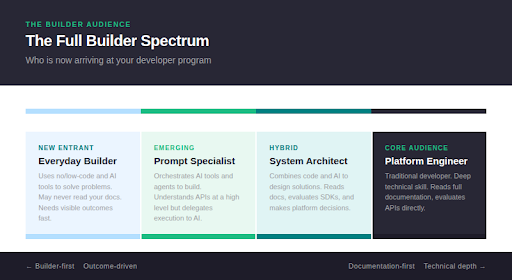
Map your full audience spectrum. There is a real spectrum from everyday builders through prompt specialists to system architects to platform engineers. Traditional developers cluster toward one end; builders span the rest. Your program needs content, support, and community models that serve multiple points on that spectrum simultaneously, without pulling resources from the audiences you already serve well.
Define your time-to-first-win benchmark for the builder persona specifically. The "first win" for a builder looks different than it does for a developer. This means identifying the earliest moment a less technical user can experience progress with your product, then removing anything that delays it, while leaving intact the depth that developers depend on.
Orient AI toward builder acceleration. AI reduces the value of memorized technical knowledge and increases the value of orchestration, which maps directly to how builders work. Your program's AI integration should help builders move faster through smarter search, interactive walkthroughs, and generative templates. For developers, AI can assist with more advanced tasks, such as code generation and debugging. The same investment serves both audiences differently.

Conclusion
The builder persona is arriving alongside the traditional developer, not displacing them. Developer programs that recognize this have a significant growth opportunity: a fast-expanding audience of capable, motivated builders who want to use your product but need a fundamentally different entry point to get there.
The programs getting this right aren't tearing down what they've built for developers. They're extending it. They're adding outcome-first onboarding paths, building community models that celebrate visible wins, and measuring success by whether builders reach value, with or without ever reading the docs.
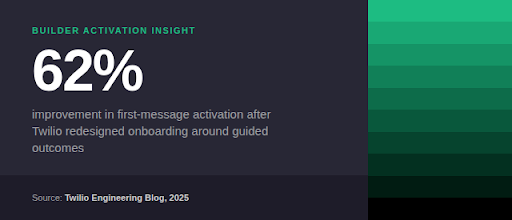
The companies moving fastest on this (Twilio, HubSpot, MongoDB) aren't treating it as a rebrand. They're restructuring their activation surfaces while preserving the technical depth their developer audiences depend on. Both audiences are growing. The question is whether your program is designed to capture both.
Want to pressure test your developer program against the builder model? Talk to a Catchy strategist →
Frequently Asked Questions
What is Builder Relations?
Builder relations is an expansion of developer relations that broadens the target audience to include anyone using tools (including AI and no/low-code platforms) to solve a business problem or create something new. It adds an outcome-driven enablement layer on top of the technical education and community infrastructure that traditional developer programs already provide, designed to help a less technical population of builders achieve visible results quickly.
How is a 'builder' different than a 'developer'?
A developer typically has formal coding skills and is comfortable learning a platform through documentation. A builder is defined by intention: they have a clear problem they want to solve and access to the tools to act on it, regardless of technical background. Builders may include non-engineers, citizen developers, AI-assisted creators, and traditional developers. The builder category includes developers as a subset, which is why the shift to builder relations is about expanding a program's reach rather than reorienting it away from its core audience.
Does adopting a builder relations model mean deprioritizing developers?
No. The developer audience remains foundational to most developer programs, and the infrastructure built to serve them (documentation, API references, SDKs, technical community) stays essential. Builder relations adds a second layer designed for a different entry point and a different definition of success. Done well, it grows the addressable audience without cannibalizing the developer experience.
Should I rename my DevRel team to Builder Relations?
The rename is less important than the strategic expansion it represents. Whether or not you change the title, the core question is whether your program has something to offer the builder persona, in addition to what it already offers developers. A program that offers only one answer for everyone ("start with the docs") will increasingly struggle to engage the broader audience arriving at the door.
What metrics matter most for builder programs?
Time-to-first-win is the most important leading indicator for the builder audience. It measures how quickly a new builder reaches a visible, meaningful outcome with your product. Supporting metrics include activation rate, workflow completion rate, and early-stage retention. Traditional reach metrics (page views, API calls, community size) remain valid signals for the developer audience and shouldn't be abandoned. They need a builder-specific complement alongside them.
How does AI change developer program strategy?
AI accelerates the builder shift in two directions: it expands the builder population (by making it easier for non-engineers to create things) and it changes what builders need from a program. Many builders will never engage directly with your documentation, SDKs, or APIs. Their AI tools will do that on their behalf: read your docs, interpret your MCP servers, and execute against your APIs without the builder needing to understand any of it. This means the quality and machine-readability of your technical infrastructure matters more than ever, even as fewer humans read it directly. Programs that invest in AI-consumable documentation, well-structured MCP servers, and outcome-first builder onboarding are building for where the majority of new users are coming from, without leaving their existing developer base behind.
How should DevRel teams adapt to the builder model?
DevRel teams should expect their scope to expand rather than shift. Serving the traditional developer audience remains the core: technical content, community, documentation support, and product expertise. What grows is the need to also design activation surfaces, onboarding paths, and community models for a less technical audience. This means working more closely with product and UX, and measuring builder-specific outcomes alongside the traditional DevRel metrics.