
How to Set Developer Program Goals Before You Budget

Andrew Gordon, Senior Strategist
Table of Contents

Right now, somewhere in your org, a number is being decided. The developer program budget for next fiscal year is moving from an educated estimate to a line item, and once it lands, it sets the boundary on everything the program can do for the next twelve months.
The conversation around that number tends to default to activity. What are we going to do?
More hackathons? A refreshed docs site? A YouTube series? A bigger conference presence? Each one sounds reasonable on its own. Each one has a champion who can argue for it. And that is exactly the problem, because the question that actually determines whether the program works is not "what should we do?". It is "what should we do, given that we cannot do everything?".
That constraint is the whole game. A developer program budget is finite, attention is finite, and the team running the program is finite. Every tactic you fund is a tactic you chose over something else. So the strategic work is not assembling a list of good ideas. Rather, it is selecting a coherent set of tactics against a specific goal, for a specific audience, knowing the budget will not stretch to cover all of them.
Why a Tactic's Value Depends on the Goal
The instinct most teams carry into planning is that tactics are good or bad in some general sense. Hackathons are good. Docs are good. Paid media is good or it is wasteful, depending on who you ask. We rank them, we argue about them, and we fund the winners.
But a tactic is not good or bad. It is good for something. For example, a hackathon is one of the strongest things you can do to build community and surface champions, because it creates the conditions for developers to engage deeply and to meet each other. That same hackathon does very little to grow broad awareness, and it is close to irrelevant if your goal this year is to accelerate enterprise deals. Nothing about the hackathon changed. The goal changed, and the goal is what assigns the value.
This is why a list of strong tactics is not a strategy. You can fund six excellent tactics that each serve a different objective and end up with a program that is busy, expensive, and pointed in no particular direction. The tactics were never the issue. The absence of a goal to measure them against was.
How Audience Changes Which Tactics Work
Even once you have a goal, there is a second variable that quietly reorders everything: who you are actually trying to reach.
A developer, a technical decision maker, and a business decision maker are not the same audience wearing different titles. They ask different questions and they trust different signals.
A developer wants to know whether the thing actually works, whether their peers respect it, and whether they can get started fast. They trust other developers, and they are largely unmoved by marketing aimed directly at them.
A technical decision maker is asking whether their team can build with it and whether it scales, and they tend to follow the signals coming up from the engineers below them.
A business decision maker is asking whether it is a safe bet and what the return looks like, and they rarely evaluate the technology themselves. They evaluate the people who evaluated it.
So the same tactic shifts in value depending on which of these you are speaking to. A deep technical blog post is high-value for the developer and the technical decision maker and nearly invisible to the business buyer. A co-marketing partnership or an app showcase carries real weight with the business decision maker and means comparatively little to the developer in the trenches. Pick the right tactic for the wrong audience and you have still misallocated the budget. The motion looks like progress, but the targeting is off.
Why a Focused Program Beats a Little of Everything
Put the variables together and the shape of the work becomes clear: you have a goal; you have an audience that goal depends on; and you have a budget that will not fund everything that sounds good. The job is to select the tactics that serve this goal for this audience, and to consciously decline the ones that serve a different goal you are not pursuing this year.
The trade-offs that make this selection hard are easiest to see when you lay a few common objectives side by side.
Growing awareness leans heavily on reach. Broad visibility is the point, and deep engagement or retention is not what you are buying yet.
Driving adoption balances depth against reach, because developers have to both discover the platform and actually start building on it.
Building community leans into network and retention. The goal is a self-reinforcing ecosystem where developers support each other, and that flywheel is slow to turn and worth the most once it does.
Activating champions concentrates on influence and depth and accepts low reach. You are investing heavily in a small number of passionate advocates because their influence travels.
Enabling enterprise deals runs on influence and depth aimed at decision-makers, and accepts lower retention because the commercial sales cycle takes over from there.
Improving the product is almost all depth, concentrating on the power users whose feedback is good enough to shape the roadmap.
Set a few of these next to each other and the tension is obvious: a program built for community is making a fundamentally different bet than one built for champions, and neither is configured to drive broad awareness. No single program can sit at the top of every dimension at once. A program tuned tightly to one goal will tend to outperform a program that spreads itself thinly across all of them, because the thin version never accumulates enough weight in any single direction to move the outcome that matters.
Pressure-Testing Tactic Choices Before You Commit Budget
The hard part of all this is that the trade-offs are abstract right up until the money is committed, and by then they are no longer trade-offs. They are just what you funded. So part of how we approach this work is to make the choices visible while they are still cheap to change.
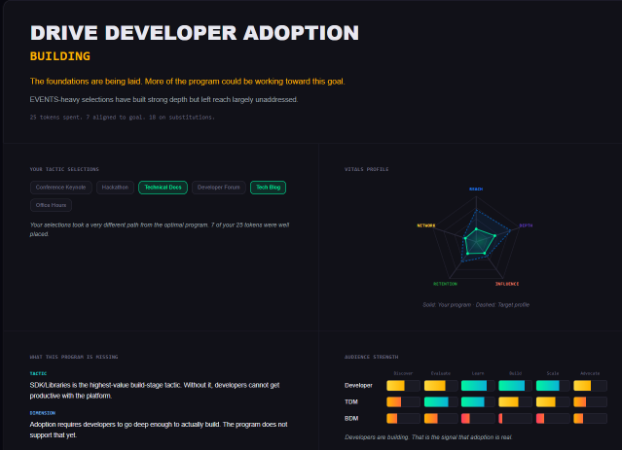
At Catchy, we built a simulator to help our strategic partners drive alignment by exploring goals and trade-offs in a low-stakes setting. When interacting with the simulation, you pick a goal and an audience, you get a fixed token budget, and you allocate it across tactics. As you go, the program's strategy profile shifts in real time, and you can see directly what each choice buys you and what it quietly costs somewhere else. Spend your budget on tactics that serve a different goal than the one you picked and the gap shows up immediately, with no real money on the line.
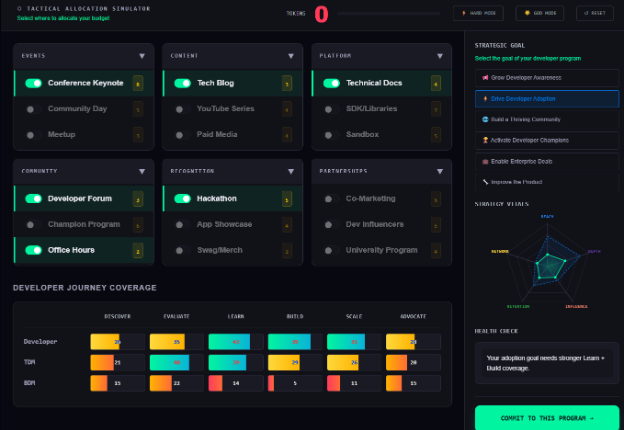
The value is not the score at the end. It is that it turns an abstract planning conversation into something concrete a whole team can look at together. People stop arguing for their favorite tactic in isolation and start seeing how the pieces add up, or fail to. It is a low-stakes way to have the real conversation before the real budget forces it.
Why Planning Season is the Time to Align on Goals
A goal can only do its work if the people funding the program and the people running it share the same one. That sounds obvious, and on a kickoff slide it always is. The real version is more demanding: it is the agreement on the audiences and outcomes that matter, and those that do not. Naming what you are saying no to is what turns a stated goal into a goal that can actually guide decisions.
This alignment is hard to reach in the middle of the year, when the budget is already allocated and every tactic already has a champion defending it. It is much easier to reach while the number is still soft and the choices are still open. The planning-and-budgeting window is the rare moment when the whole team is looking at the same blank page at the same time. That is the moment when alignment is cheapest to build and most valuable to lock in, because everything the program does for the next twelve months inherits from the agreement you reach here.
Turning Goal Alignment into a Developer Program Plan
The point of all of this is not a verdict on which tactics are right. There is no universal answer, because the answer is a function of your goal, your audience, and your budget, and those are yours to set. The point is that the act of selecting deliberately, against a goal everyone has agreed to, under the budget you actually have, is the strategic work itself.
How you reach that alignment matters less than that you reach it. For some teams it is a structured exercise like the simulator, where the trade-offs get pressure-tested with something concrete on the table, and that is work we love to support. For others it is simply a deliberate conversation that reaffirms what everyone is building toward before the budget locks. Either way, the planning stage is where that alignment gets unlocked, and it is the alignment, far more than any individual tactic, that carries the program toward whatever success you have defined for it.
Want to work through how your planning sessions need to evolve to help hit your developer program's goals? Talk to a Catchy strategist →

